ModernBERT: Pre-Training and Post-Training
MWS AI has released access to two Russian-language ModernBERT models and tested additional training. The best result on seven tasks of RussianSuperGLUE was shown by the ready-made base model: 74.12% versus 70.88%.
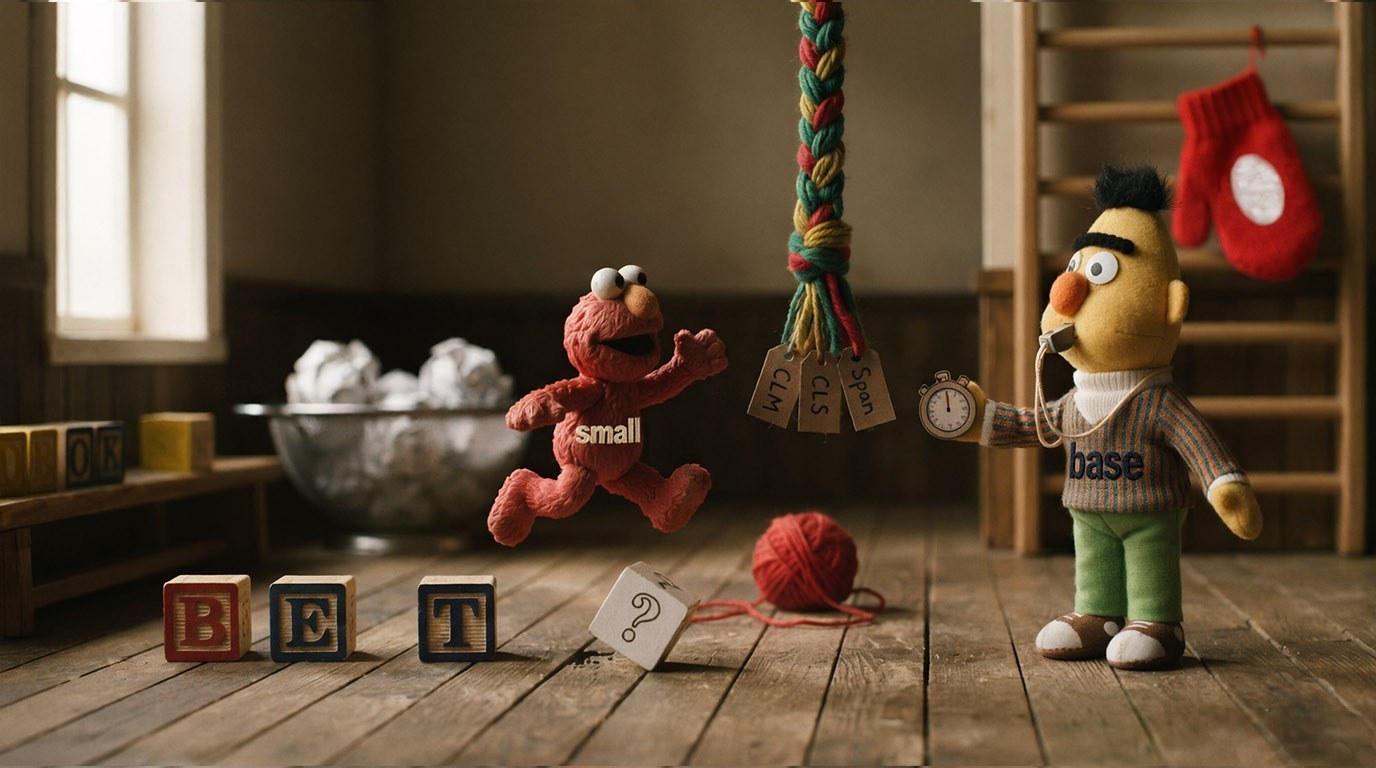
The team trained models of two sizes. The Small version was created from scratch, while the Base version was adapted from the multilingual mmBERT. A shared tokenizer with a vocabulary of 50,368 tokens was developed for both versions. Like BERT, ModernBERT generates token vectors with context awareness but alternates layers with local and global attention.
The Small model was initially trained to reconstruct hidden fragments of Russian-language texts, then English materials, Wikipedia, and code were added. In the final stage, the Base model was used as a teacher: it transferred information about the probabilities of possible responses to the Small model. In total, the Small model processed approximately 140 billion tokens, while 88 billion tokens were used for adapting the already trained mmBERT-base.
To test post-training, the encoders were trained on dialogues. Researchers compared standard masking, temporary switching to next-token prediction, transferring continuation information via [CLS], and detecting substituted fragments. After the experiment, the model was required to return to bidirectional attention. The greatest improvement was achieved by the Base model from the Russian developer: its average accuracy increased from 70.88% to 74.12%.