
Netherlands developing colored solar blocks based on LEGO principle
Researchers at Eindhoven University of Technology have created prototypes of transparent blocks with fluorescent dyes that collect light and direct it to solar cells on the side edges.
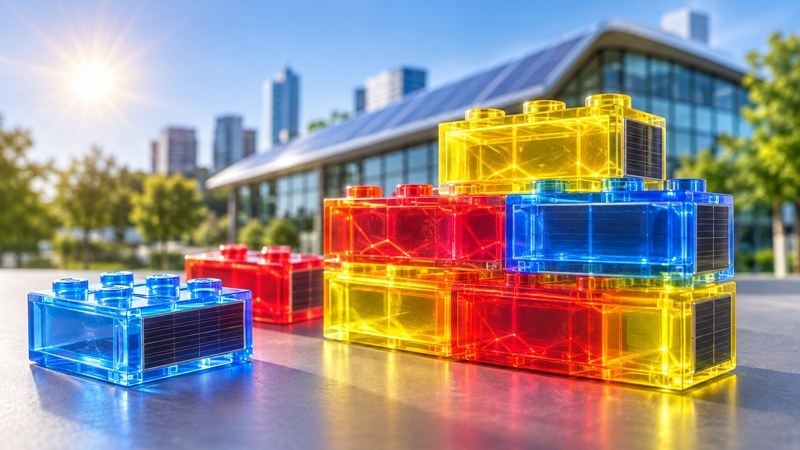
The project is named L.E.G.O.—Luminescent Electricity Generating Objects. The team produced red and yellow samples from a transparent silicone polymer, PDMS. The dye inside the material absorbs part of the incoming light and re-emits it at a longer wavelength. Due to internal reflections, the light travels to the edges of the block, where it can be converted into electricity.
The design plans to use perovskite photovoltaic cells. The blocks will be able to collect direct sunlight and diffuse light, as well as operate under artificial lighting. Their characteristics will depend on the dye, shape, and method of connecting the elements.
The development is at an early stage. Scientists are studying how the arrangement of blocks affects light transmission and are addressing challenges related to connecting solar cells and electrical contacts. The expected efficiency is less than 10%. The developers aim to integrate energy harvesting into objects that already serve a useful function—such as bus stops, benches, and noise barriers. The generated electricity could power lighting or small electronic devices.
The first intended application will be educational kits called SparkBlocks, which the team is developing with Canadian company Block&Code. In the future, researchers plan to scale the blocks up to the size of construction bricks and test their suitability for urban infrastructure. The timeline for commercial release and final specifications have not yet been determined.