Euclid discovers the most distant quasar with a black hole of 360 million solar masses
Euclid has discovered quasar J1504+6252, whose light originated from a universe just 630 million years old. The mass of its black hole is approximately 360 million solar masses.
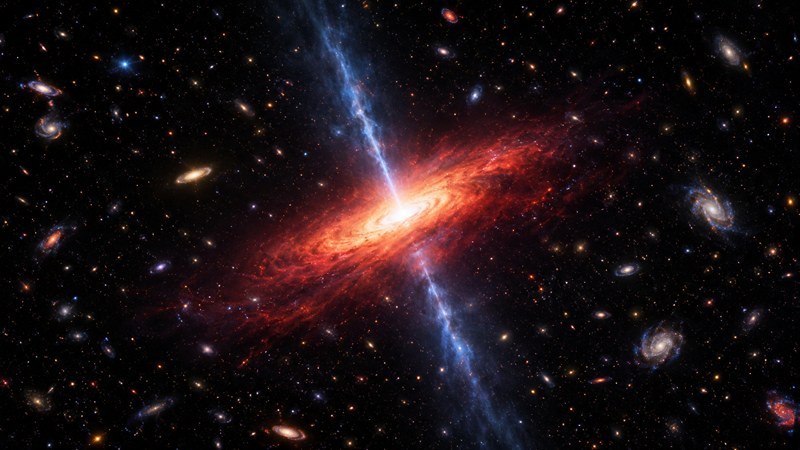
The quasar was found among millions of objects using data from approximately 18 months of Euclid observations. Its nature was confirmed by ground-based and space observatories, including the Hubble and James Webb telescopes. The latter allowed scientists to estimate the mass of the central black hole. The object has been named Dún Aonghasa.
The quasar's redshift is 8.13, meaning it is observed as it was roughly 13.1 billion years ago, when the universe was about 630 million years old—just 5% of its current age. This object sets a new record for Euclid, pushing the previous observational boundary back by about 40 million years.
However, Dún Aonghasa is consuming matter relatively slowly. This suggests that the black hole likely experienced periods of exceptionally rapid growth in its early stages, posing challenges for models of the formation and evolution of the first supermassive black holes. In its first year and a half, the mission has identified 31 ancient quasars, including 12 objects with a redshift greater than 7.