Gaia may detect thousands of planets but cannot determine their orbits
Researchers have prepared a catalog of 15,120,984 simulated systems to test the search for companions using Gaia DR4 data. A companion can be detected, but its orbit cannot be determined.
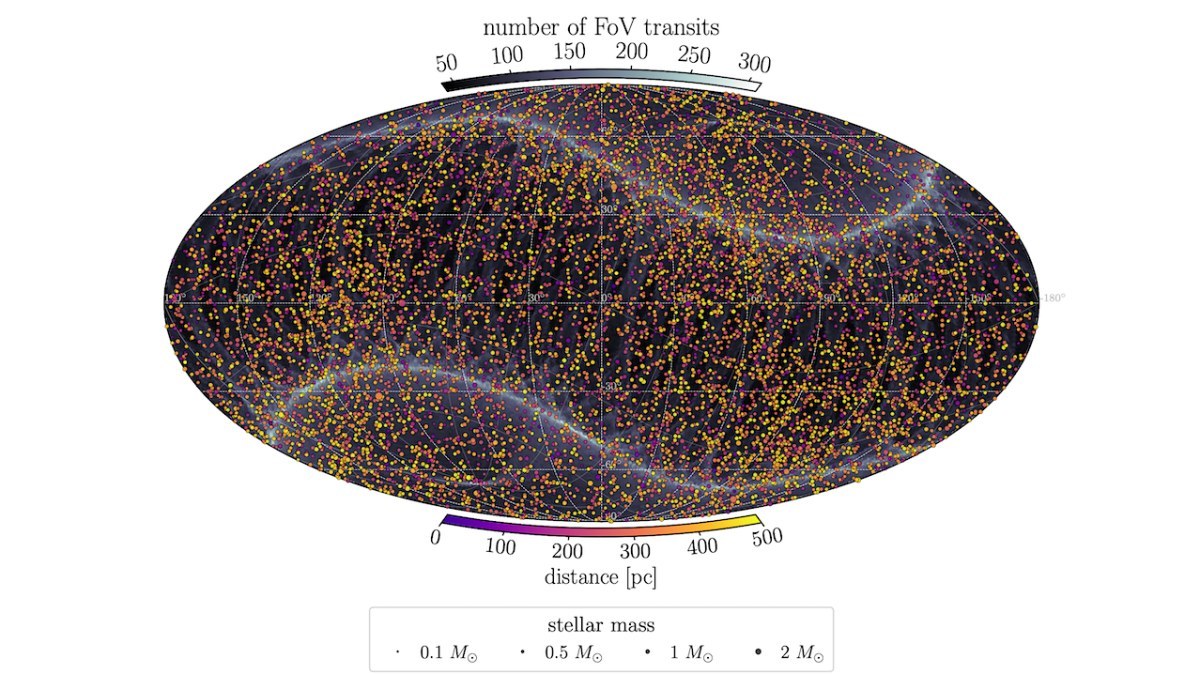
An international group of astronomers has published the Epochalypse catalog, software code, and training materials to test algorithms ahead of the fourth data release from Gaia. This release is expected to include astrometric measurements for individual epochs for billions of sources for the first time.
The catalog includes models of stars without companions, with one companion, and with two companions. Researchers have pre-saved the exact parameters of each system, allowing algorithms to be tested not only for their ability to detect a signal but also for the number of false positives.
Calculations revealed limitations for long-period orbits. If the orbital period exceeds the duration of Gaia DR4 observations, the telescope records the deviation in the star's motion but does not have time to trace the full orbit. For a release spanning approximately 5.5 years, orbits with a period of around 3.9 years proved to be the most suitable.
In one of the simulated samples, periods were successfully determined in 106,339 cases, whereas in 97,969 systems, a companion was detected but its period remained unknown. The authors believe the catalog will help distinguish between simple companion detection and the full determination of its mass and orbit after the release of real Gaia DR4 data.