Euclid detects ancient cosmic beacons that emerged at the dawn of time and shine as bright as a trillion Suns
The Euclid telescope has discovered 31 ancient quasars, including two of the earliest known: they were already radiating as brightly as a trillion Suns when the Universe was 670 million years old.
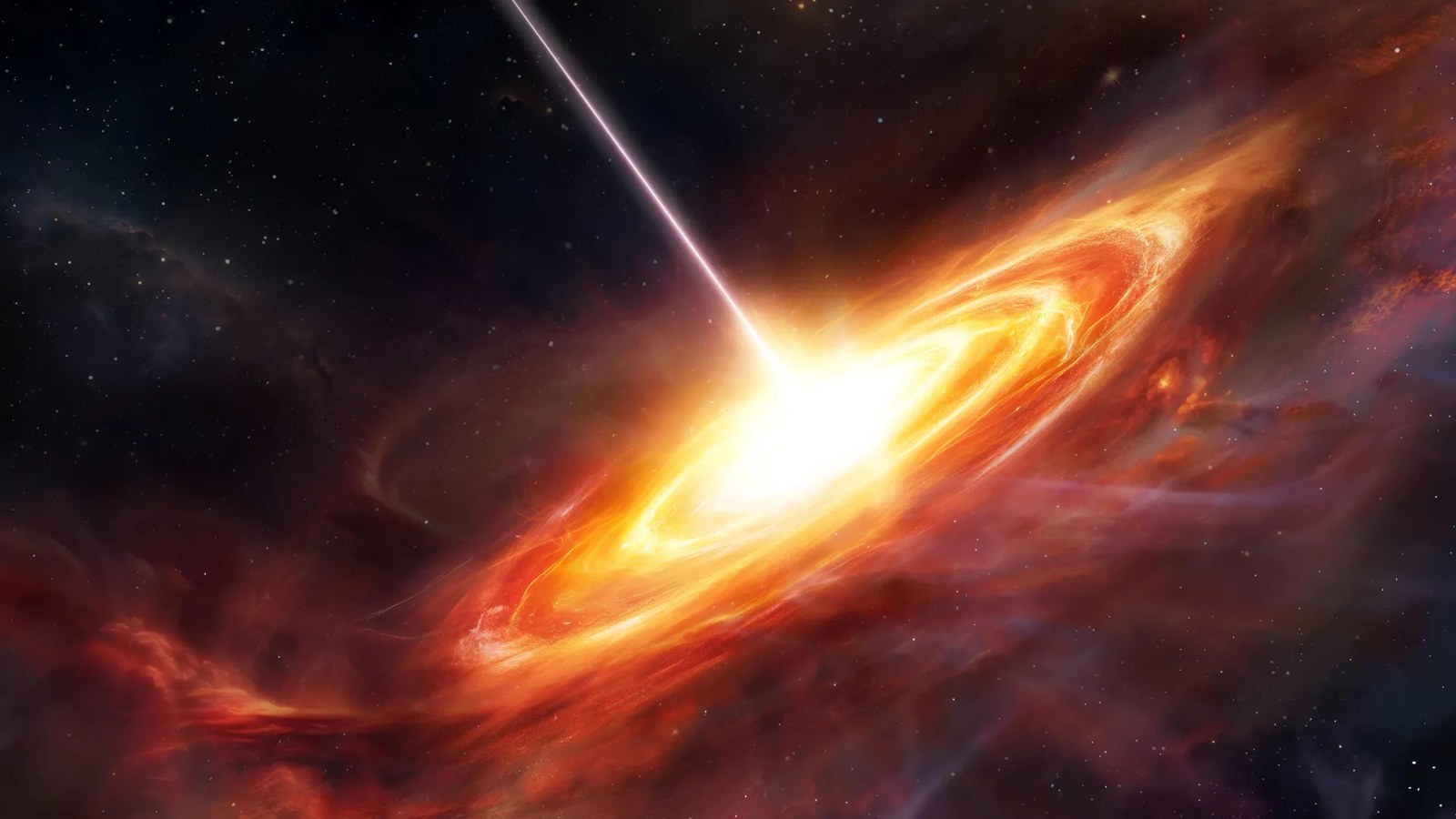
Quasars form at the centers of galaxies when gas and other matter rush toward a supermassive black hole. This process releases an enormous amount of energy, and the galaxy’s core begins to shine many times brighter than the rest of its parts.
Two objects from the new sample have become the earliest quasars ever observed. Their redshift values are 7.77 and 7.69. This indicator helps determine how far away an object is and how long ago its light began traveling toward Earth. Both quasars existed within the first 670 million years of the Universe’s history.
Previously, astronomers primarily found the brightest ancient quasars, as faint sources were difficult to detect and distinguish from stars closer to Earth. Euclid is capable of surveying large areas of the sky, capturing detailed images, and recording faint infrared radiation. As a result, the telescope has enabled the detection of not only bright but also dimmer objects.
Studying early quasars helps understand how the first galaxies formed and how supermassive black holes grew. One of the detected objects is located within a galaxy rich in gas and dust, where new stars are being born intensively. This provides an opportunity to study the environment of a black hole at an early stage of the Universe’s development.
All findings were made as part of Euclid’s wide sky survey. The mission’s primary goal is to investigate the dark Universe, but its observations also allow for the study of the cosmos’s composition, history, and evolution, including the reionization period, when radiation heated and ionized the surrounding gas.