Astronomers trace how one star engulfed another in the Andromeda galaxy
An international team of researchers has reconstructed a rare process: a small star plunged into the gaseous envelope of a giant, gradually approached its core, and, according to the authors, merged with it. Observations of the system AT 2025abao in the Andromeda galaxy allowed the study of one of the most elusive stages in the evolution of binary stars.
The results of the study were published on November 18 in the journal Nature. Scientists combined archival observations with data obtained before and after a powerful outburst in October 2025. This made it possible to trace the system's development over several years and compare changes in its brightness and spectrum with theoretical models.
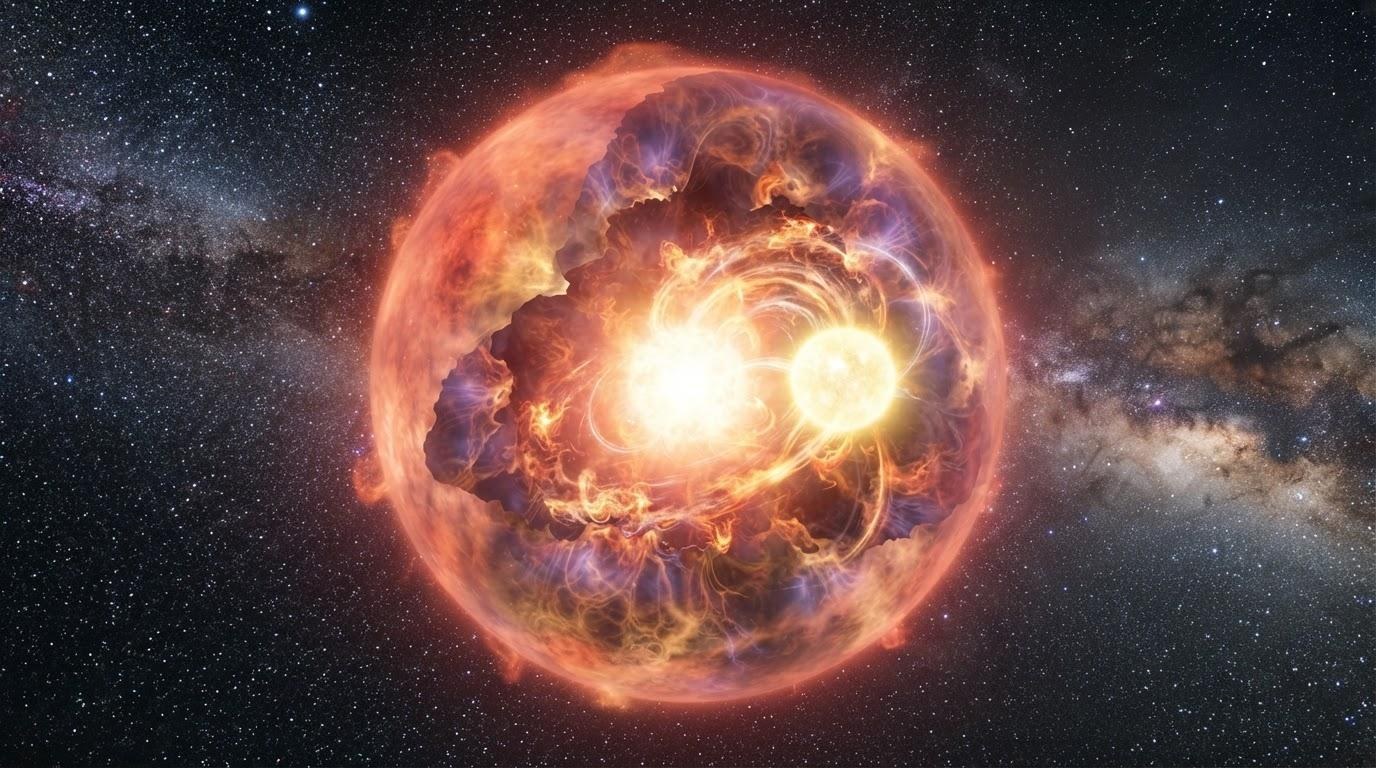
Before the outburst, the system consisted of two stars. The mass of the larger one was estimated at approximately seven solar masses, and its radius exceeded the solar radius by about 350 times. The mass of the smaller companion was estimated at roughly 0.7 solar masses.
According to the proposed scenario, around 2018, the smaller star began plunging into the outer layers of the giant. Both luminaries found themselves inside a common gaseous envelope. Moving through the matter, the companion lost orbital energy and spiraled closer to the core of the more massive star.
The released energy heated the gas and sustained a gradual increase in the system's brightness for about seven years. Thus, observations allowed tracing how braking within the common envelope alters a star's orbit and transfers energy to the surrounding matter. The study in Nature.
A sharp outburst began on October 17, 2025. Later, the system was studied by the James Webb Space Telescope: its observations took place on December 24, 47 days after the peak brightness. Infrared data helped assess the dust and ejected matter, as well as clarify the picture of what happened.
The authors of the new work link the outburst to the merger of the companion and the giant's core. According to their estimates, the event was accompanied by the ejection of matter with a total mass of about 0.1–0.2 solar masses. However, the ultimate fate of the central object requires further observations: the Nature report separately notes the need for additional confirmation of the merger. Nature Portfolio.
A common envelope is considered an important stage in the evolution of close binary systems. Its formation may end in a merger, but another outcome is also possible: the stars shed the surrounding gas and remain as separate objects on significantly closer orbits.
The peculiarity of AT 2025abao lies in the rich set of observations before and after the outburst. Typically, astronomers have to reconstruct such processes from long-formed remnants. Here, changes were tracked as the event unfolded, providing an opportunity to test calculations of energy transfer and the ejection of stellar envelopes. NASA.