
Memory and Playbooks for Claude Code, Codex, and Other Agents
The article's author describes two open-source tools for working with AI agents: Open Second Brain stores shared context, while Agentic Playbooks automates task sequences.
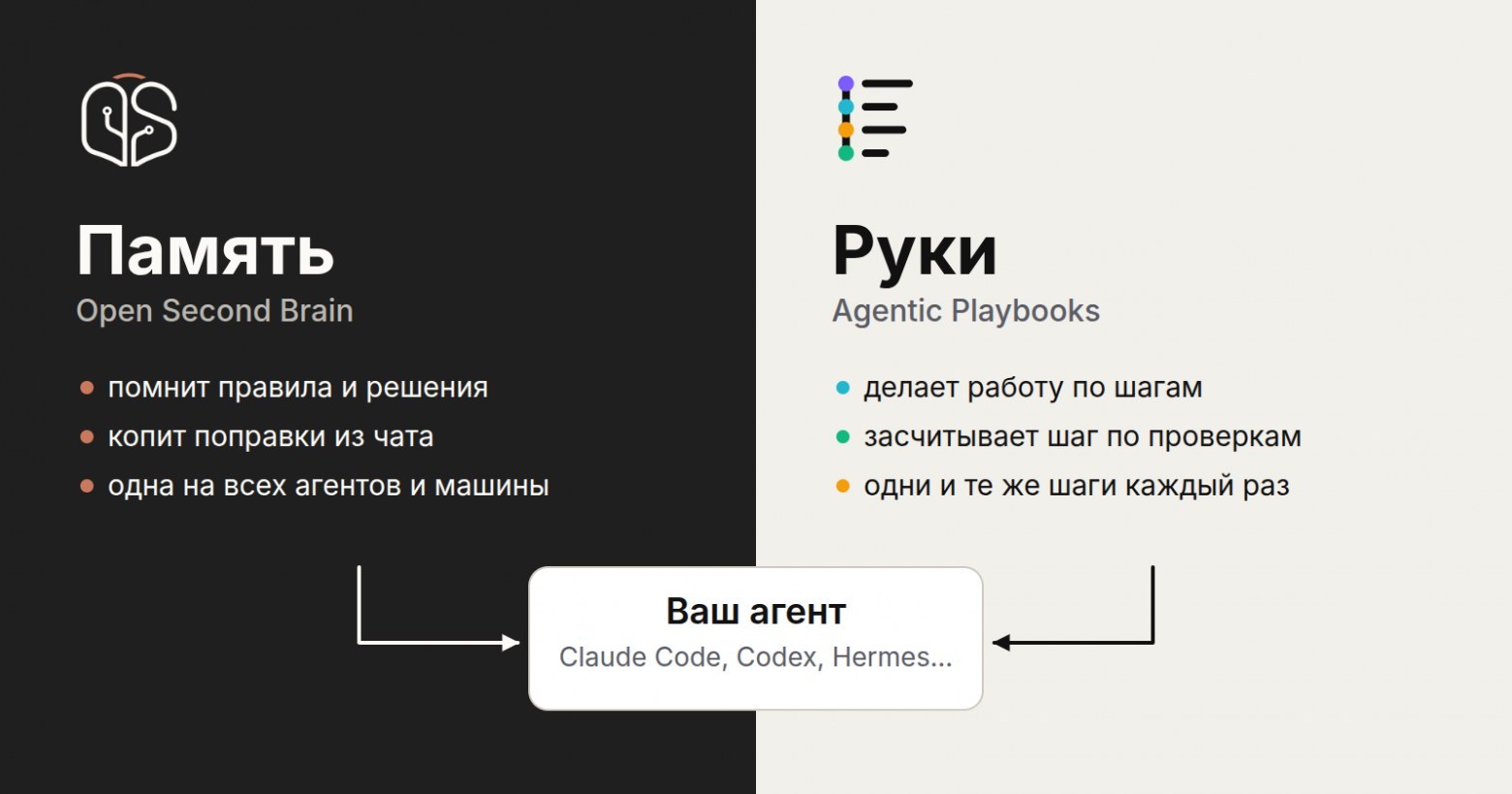
Open Second Brain connects to agents via MCP servers and hooks. It records observations, decisions, and events, then converts recurring signals into rules. A single adjustment does not create a rule: typically, three identical signals are required, after which the rule undergoes a probationary period. Unused or frequently violated rules are sent to quarantine and retired. Memory is accessible to Claude Code, Codex, OpenCode, Hermes Agent, Grok Build, and other MCP hosts.
Agentic Playbooks define workflows in a YAML graph: individual steps can be executed by different agents, scripts, or nested playbooks. For each step, a model, profile, prompt, and fallback options are specified. The system credits a stage only after checks specified in the playbook, but this confirms the completion of the form, not the quality of the result. For example, a successful review does not mean the code can be immediately accepted.
Neither project uses telemetry. Open Second Brain does not synchronize data between devices on its own: the author does this via Syncthing. According to him, the project has been active for six months, released 193 versions, and gathered over 600 stars. Development was conducted autonomously: the agent itself tracked news, created tasks, and selected them for work using Agentic Playbooks.