Beyond Neptune’s orbit, there may be not one but two 'Ninth Planets'
Scientists have suggested the existence of a separate Planet X2 beyond Neptune’s orbit: models indicate an object with a mass of about two Earths. This is not Planet Nine.
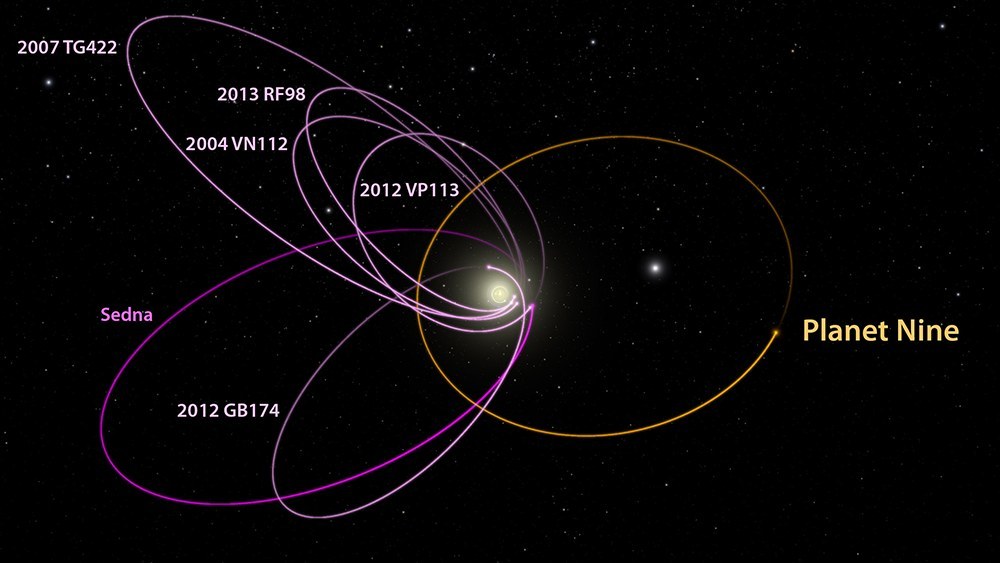
An international team from Kindai University, the University of Washington, and the University of Southern Queensland arrived at this conclusion. Researchers studied the unusual orbits of trans-Neptunian objects—icy bodies that move beyond Neptune and sometimes have a strong inclination or elongated trajectory.
Scientists modeled the evolution of the Solar System over 4.5 billion years, including the migration of giant planets. In scenarios with an additional massive body, the distribution of such objects better matched the observed data. The most suitable model was X2, with a semi-major orbital axis of 350–500 astronomical units (AU) and a minimum distance to the Sun of about 200 AU. For comparison, Neptune is located approximately 30 AU from the star.
The hypothesis of X2 does not replace the Planet Nine hypothesis. The latter suggests the existence of a different object, 4–6 times heavier than Earth; the presence of one planet does not rule out the other. However, the calculations do not yet fully align with the distribution of semi-major axes identified in observations from the Dark Energy Survey project.
The authors believe the model requires refinement. Observations from the Vera C. Rubin Observatory in Chile will help verify it: the observatory will gather more data on distant objects and allow comparison of their orbits with predictions.