Lotus stems and bacteria helped create a generator powered by water evaporation
The device continuously generated electricity for over a month and was able to power several portable electronic devices.
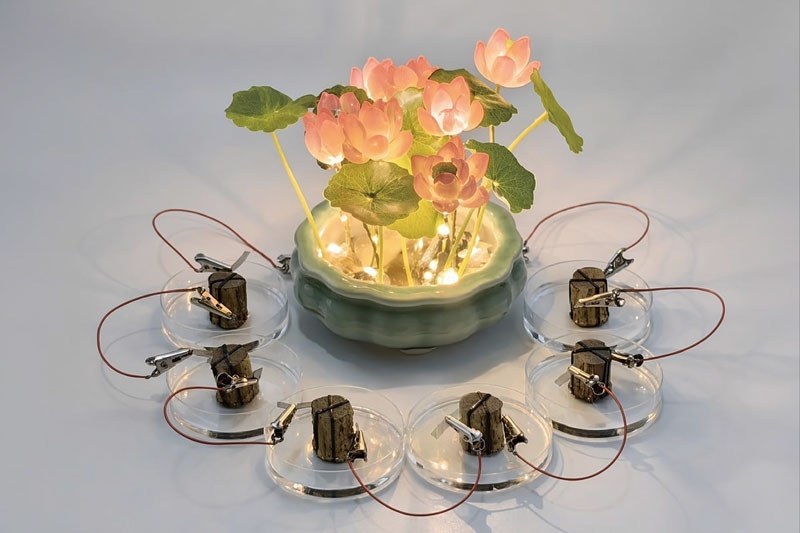
Chinese scientists have developed a low-power generator that converts the energy of water evaporation into electricity. The technology is based on lotus stems, electrically active bacteria, and porous electrodes. The device belongs to the field of hydrovoltaics, which studies energy generation through the interaction of water with materials.
Researchers used the hollow microchannels of lotus stems, which ensure the directional movement of water and ions. Inside them, they formed a biofilm from Geobacter sulfurreducens bacteria, capable of transferring electrons to the external environment. This improved conductivity and charge transfer, enabling the generation of electric current during water evaporation.
A single generator produced a voltage of 1.48 V and a current of up to 0.73 mA, with stable operation lasting over 30 days. To test scalability, scientists assembled a matrix of 256 devices, which was able to power electronic clocks with backlighting, a calculator, an e-ink display, and a mobile phone.
The development is seen as a promising energy source for autonomous sensors used in environmental monitoring and agriculture.