What is RGB MiniLED and how does a TV with this backlight differ from other screens
RGB MiniLED is an LCD TV backlight in which red, green, and blue crystals are individually controlled in each zone. This helps achieve purer colors.
A liquid crystal panel does not emit light itself: it functions like blinds, allowing light to pass through from a lamp located behind it. In 2004, fluorescent tubes began to be replaced with LEDs, but the TV remained an LCD screen—only the light source changed.
LEDs were divided into zones with independent brightness to improve the display of dark areas. This led to the development of local dimming, and after the crystals were reduced in size—MiniLED. OLED does not require a separate lamp: each pixel emits its own light. MicroLED uses microscopic LEDs as the panel itself. Despite its name, QLED also remains an LCD technology but employs quantum dots in the backlight.
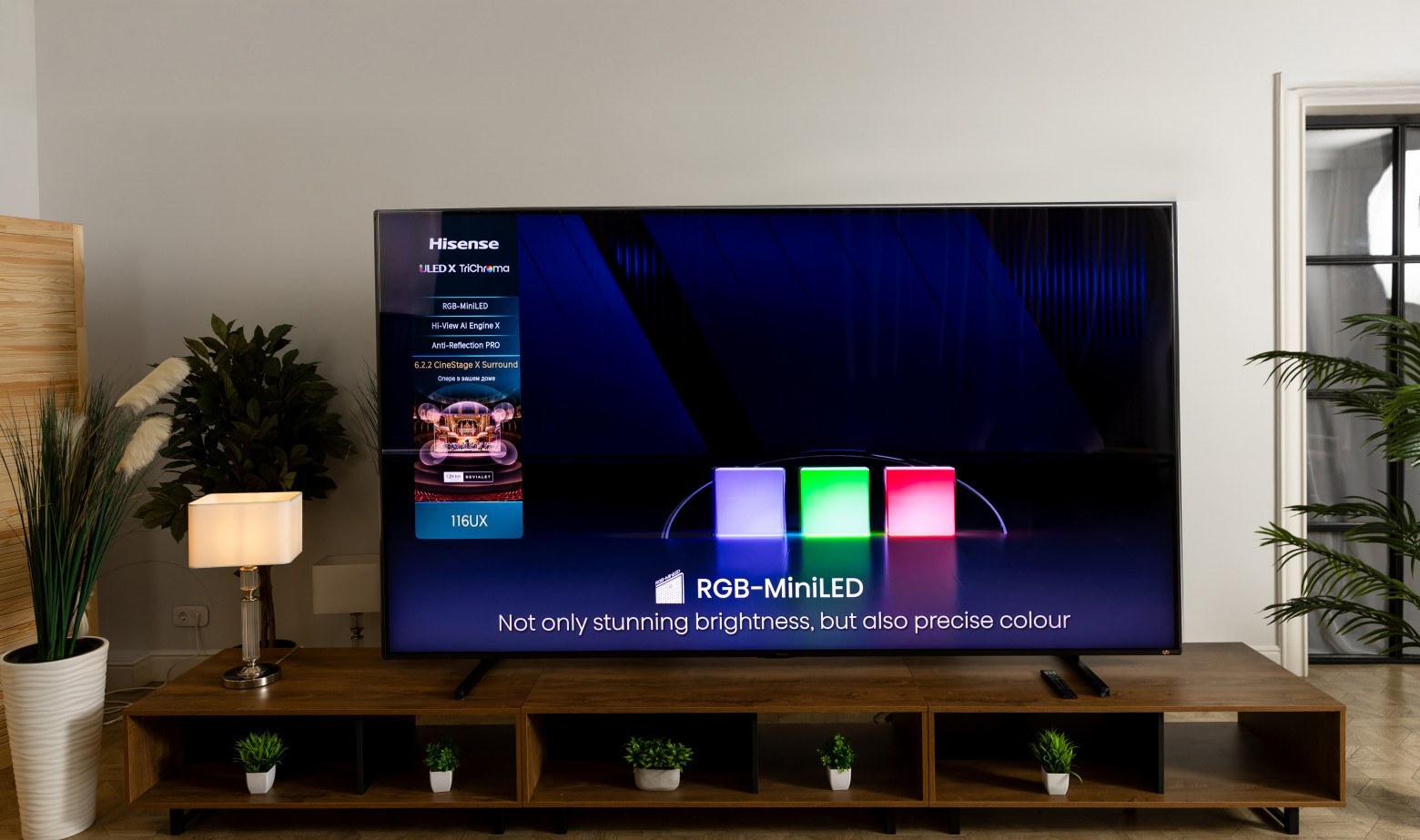
In January 2025, Hisense showcased a 116-inch TV with RGB MiniLED at CES in Las Vegas. Each backlight element contains three crystals, and the zone can change not only brightness but also color. The image is still formed by liquid crystals, while color filters control individual pixels.
Conventional LED backlighting produces white light from a blue crystal and yellow phosphor, so filters absorb a significant portion of it. RGB MiniLED uses primary colors directly. For the 116UXQ model, Hisense claimed a color gamut coverage of 95–97% of the BT.2020 palette.