Scientists Determine What Slows a Laser Sail at 75% the Speed of Light
Calculations by researchers Chao Shen and Jiazhe Li show that at 75% the speed of light, scattered light begins to slow a laser-propelled solar sail. The overall force of the laser remains directional.
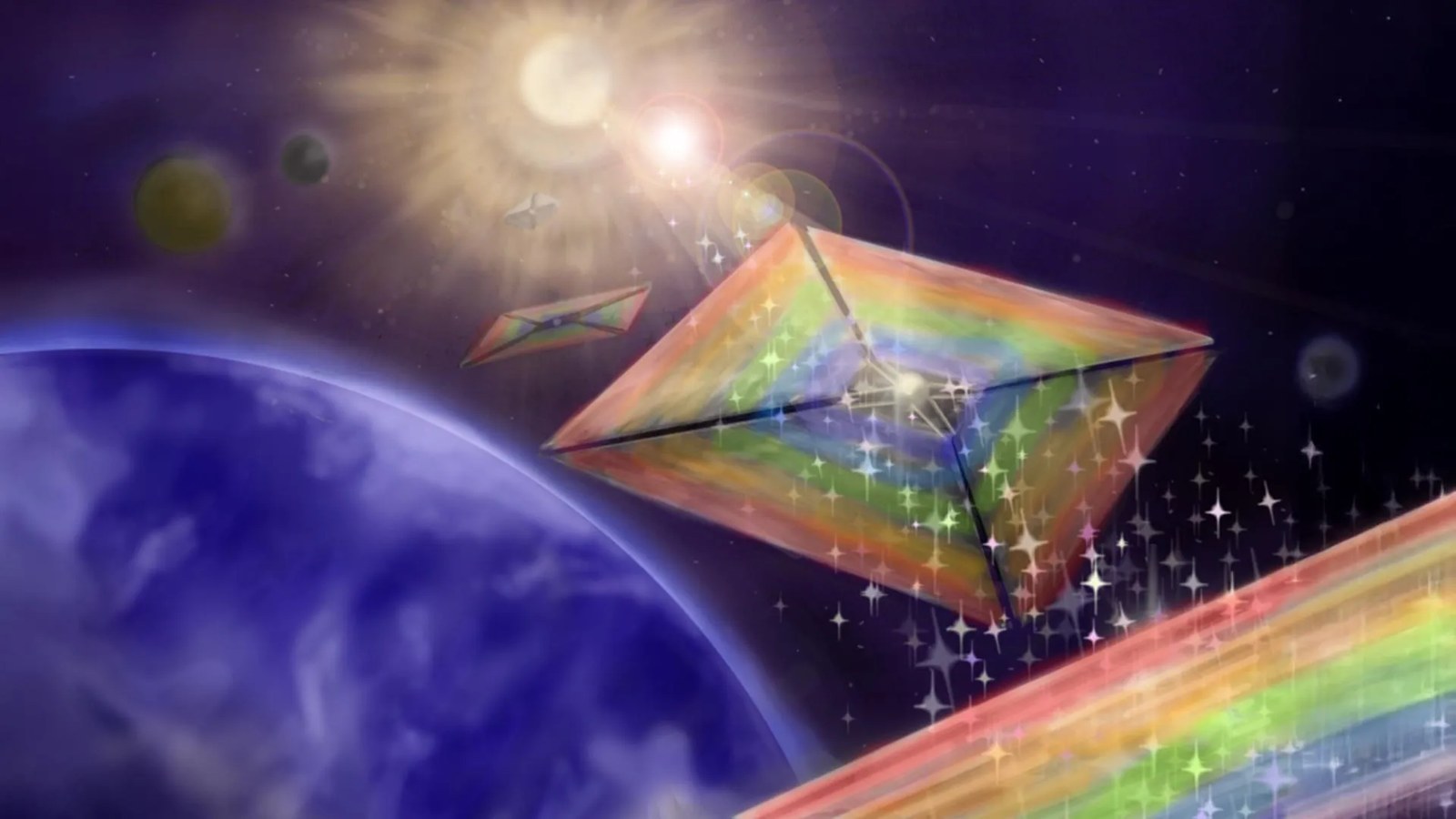
The study, published on arXiv, examines three methods of photon momentum transfer: direct impact on the sail, specular reflection, and diffuse scattering. The first process contributes the most, while the last contributes the least.
As the sail moves away from the laser, it encounters a Doppler shift: the light's frequency decreases, causing all three types of interaction to gradually produce less thrust. Upon reaching 75% the speed of light, relativistic aberration directs scattered light forward, in the direction of the sail's motion. The resulting recoil begins to act as resistance.
This does not mean the sail stops accelerating: the net force of the laser radiation remains positive, but further acceleration becomes less efficient. The calculations account only for radiation effects and assume the material is a perfect mirror. They do not consider interstellar gas and dust, heating from the powerful laser, or the curvature of spacetime. Metamaterials and photonic crystals may help stabilize the sail in the laser beam in the future, though full-fledged interstellar systems have yet to be built or tested.